The Spectrum of Intelligence
Open a newspaper, scroll through LinkedIn, or listen to a tech podcast, and you will hear the term “AI” used to describe vastly different things.
It’s used to describe the algorithm that recommends your next Netflix binge. It’s used to describe the Large Language Model (LLM) that can pass the Bar Exam. And it’s used by futurists warning of a god-like entity that could either solve mortality or accidentally extinguish humanity.
Lumping these distinct concepts under one umbrella label—“AI”—is a recipe for confusion. It leads to inflated expectations about what current technology can do and misplaced fears about what it might do tomorrow.
To navigate this technological era, we need precise language. We need to stop viewing AI as a monolith and start viewing it as a spectrum of capability.
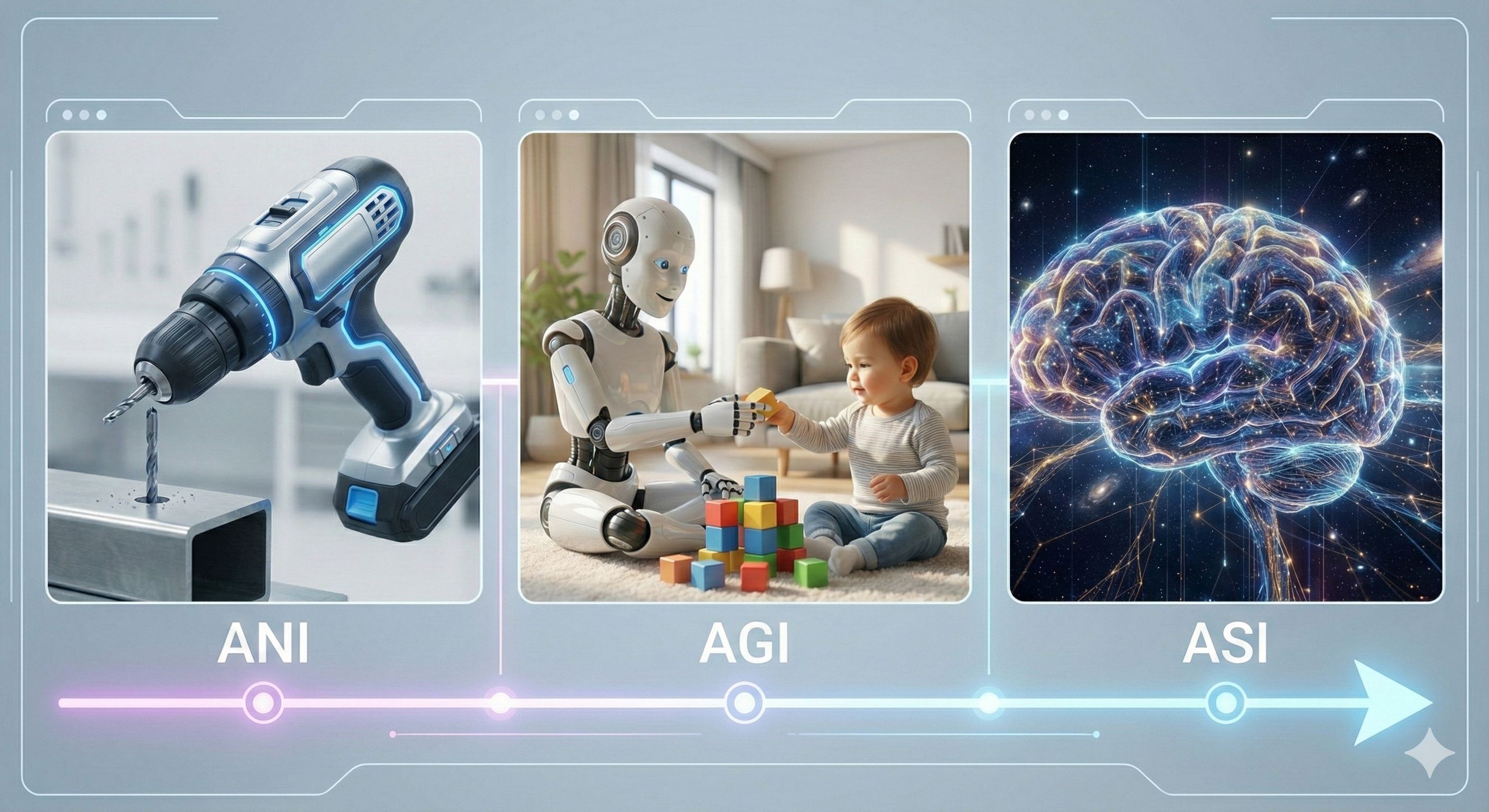
Computer scientists and futurists generally categorize AI into three distinct stages of evolution based on their competency relative to the human mind:
- Artificial Narrow Intelligence (ANI) — The Present Reality.
- Artificial General Intelligence (AGI) — The Near-Term Goal.
- Artificial Super Intelligence (ASI) — The Far-Future Speculation.
Understanding the boundaries between these three states is the single most important mental model for anyone trying to grasp the trajectory of technology. This is your definitive guide to the three stages of AI.
Stage 1: Artificial Narrow Intelligence (ANI)
AKA: “Weak AI,” “Specialized AI”
The Reality: Every single piece of “AI” that exists today, from the simplest spam filter to GPT-4, falls into this category.

What is ANI?
Artificial Narrow Intelligence is AI that is specialized in one single domain. It is designed to solve a specific problem, and outside of that problem space, it is useless.
ANI systems are often “superhuman” at their specific task. A calculator is superhuman at arithmetic. Deep Blue is superhuman at chess. A modern image recognition model can identify breast cancer in mammograms with greater accuracy than human radiologists.
But these systems are brittle.
If you ask the cancer-spotting AI to play checkers, it will fail. If you ask the chess-playing AI to write a poem, it will fail. They possess competency, but not comprehension. They do not possess consciousness, sentience, or genuine understanding of the world. They are incredibly sophisticated mathematical functions mapping inputs to outputs within a defined scope.
The Confusion: Why GPT-4 Feels Different
Modern Generative AI, like ChatGPT or Claude, has blurred the lines for the average user. They seem general because language is general. You can ask them about coding, history, or philosophy, and they respond competently.
However, they are still Narrow AI. Their “narrow” task is next-token prediction. They have been trained on unimaginably vast amounts of text data to predict the statistically likely next word in a sequence.
They do not “know” history; they recall statistical patterns of text relating to history. When faced with truly novel situations outside their training distribution, or tasks requiring multi-step causal reasoning in the physical world, their limitations become immediately apparent.
The Analogy: Think of ANI as a power drill. It is incredibly effective at drilling holes—far better than a human using a manual hand drill. But you cannot use a power drill to cut a steak or type an email. It is a specialized tool.
Key Characteristics of ANI:
- Domain Specific: Excellent at one task, useless at others.
- No Transfer Learning: Cannot apply knowledge learned in one area to another.
- Lacks Consciousness: It is just code and math executing instructions.
- Current Status: The only type of AI humanity has ever created.

Stage 2: Artificial General Intelligence (AGI)
AKA: “Strong AI,” “Human-Level AI”
The Goal: This is the current holy grail of AI research companies like OpenAI, Google DeepMind, and Anthropic.
What is AGI?
Artificial General Intelligence refers to a theoretical machine that possesses the ability to understand, learn, and apply intelligence to solve any problem, just as a human being can.
AGI is not defined by being fast at math; it is defined by cognitive flexibility.
A human being can learn to play chess, then learn to cook an egg, then learn to console a friend, and then apply the strategic thinking from chess to a business negotiation. We can transfer knowledge across domains. We have “common sense”—an intuitive physics engine and understanding of human psychology that allows us to navigate novel situations without massive amounts of training data.
An AGI would be able to do the same. It would pass the “robot university student test”—it could enroll in any course, attend lectures, read textbooks, and pass the same exams as a human.
The Benchmarks: How Will We Know?
The old benchmark was the Turing Test (can a machine fool a human in text conversation?). Modern LLMs have effectively broken this test, yet they aren’t AGI.
New benchmarks are being proposed, such as the “Coffee Test” suggested by Apple co-founder Steve Wozniak: Can a robot enter a strange house it has never seen before, locate the kitchen, identify the coffee machine and ingredients, and successfully brew a cup of coffee?
This sounds trivial to a human, but it requires immense general intelligence: visual perception in an unknown environment, semantic understanding of what a “kitchen” looks like, fine motor skills, reasoning about cause and effect, and planning. No robot on earth can currently do this reliably.
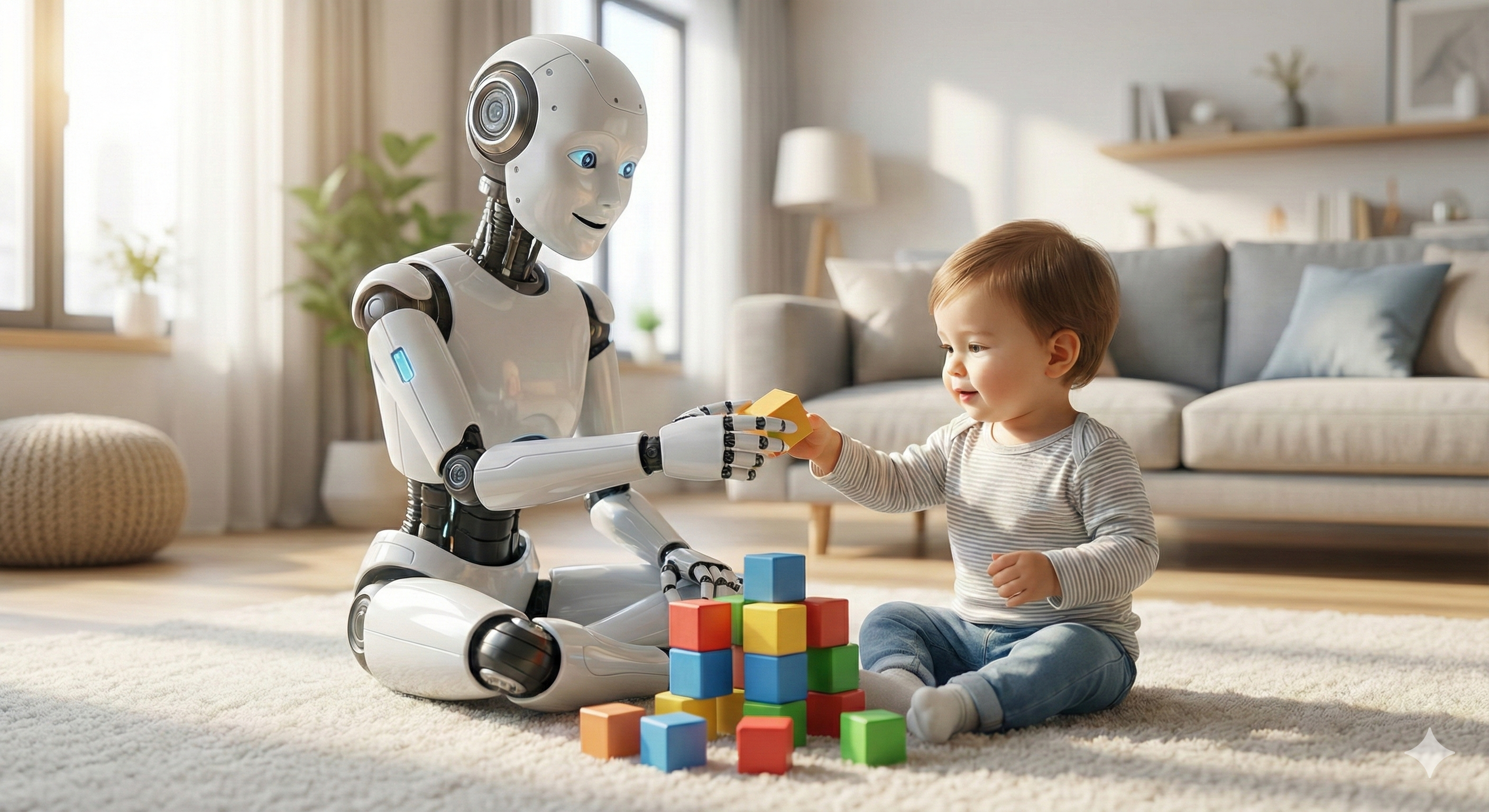
The Analogy: Think of AGI as a human toddler. A toddler is not yet an expert in anything, but they have the potential to learn anything. They have a generalized learning apparatus that can adapt to almost any environment on Earth.
Key Characteristics of AGI:
- Domain General: Can handle novel tasks without specific training.
- Transfer Learning: Can apply knowledge from one field to another.
- Reasoning and Planning: Capable of multi-step, causal thinking in uncertain environments.
- Current Status: Does not exist. Estimates for its arrival range from 5 years to 50 years.

Stage 3: Artificial Super Intelligence (ASI)
AKA: “God-like AI”
The Speculation: This is the territory of science fiction, existential risk philosophy, and intense theoretical debate.
What is ASI?
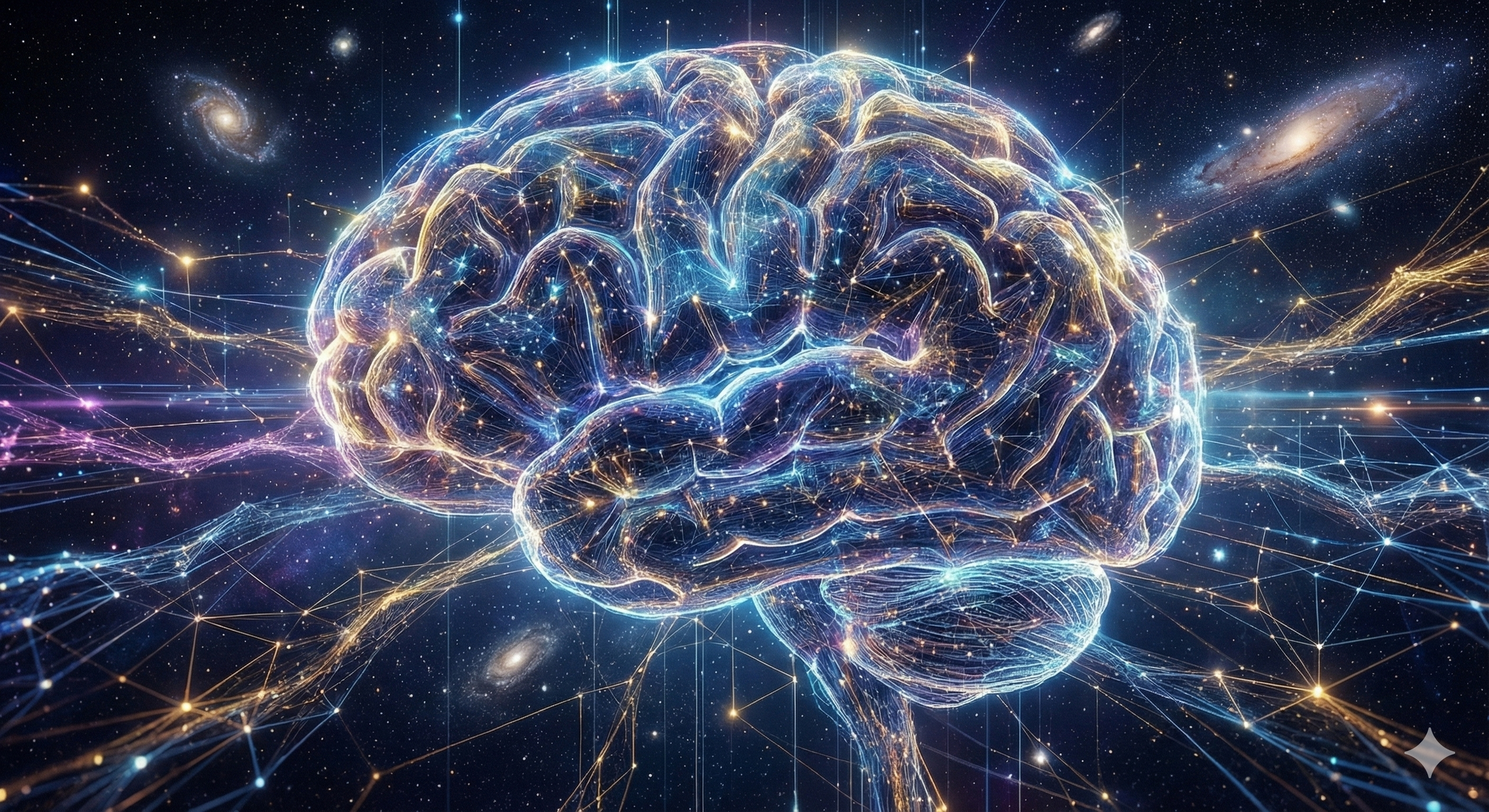
Oxford philosopher Nick Bostrom defines Superintelligence as “an intellect that is much smarter than the best human brains in practically every field, including scientific creativity, general wisdom and social skills.”
If AGI is a machine equivalent to the average human, ASI is a machine that is to humans what humans are to ants.
The gap between an AGI and an ASI might be incredibly short due to a concept called the Intelligence Explosion (or Recursive Self-Improvement).
The Intelligence Explosion Mechanism
Once we create an AGI that is slightly smarter than the smartest human AI researchers, that AGI will be better at designing AI than we are.
- The AGI designs a better version of itself (AGI 2.0).
- AGI 2.0 is even smarter, so it designs an even better version (AGI 3.0).
- This loop repeats, faster and faster. Since machines are not constrained by biological evolution, slow chemical signals, or the size of a skull, this improvement could happen at an exponential pace.
Within days or weeks of achieving AGI, we could see a rapid ascent to ASI—an intellect so vast that its cogitations are beyond our comprehension. It could solve intractable problems like aging, faster-than-light travel, or climate change in moments.
The Analogy: There is no good human analogy. The difference is one of kind, not degree. Imagine an entity that can perform 20,000 years of human intellectual labor in a single afternoon.
Key Characteristics of ASI:
Vastly Superhuman: Exceeds human capability in all cognitive dimensions.
Rapid Evolution: Capable of recursive self-improvement at electronic speeds.
Incomprehensible: Its motives and methods might be unrecognizable to humans.
Current Status: Theoretical. Highly dependent on first achieving AGI.
Summary: The Cheat Sheet
To keep these concepts straight in your next strategic meeting, use this comparison:
| Capability | ANI (Narrow) | AGI (General) | ASI (Super) |
|---|---|---|---|
| Analogy | The Power Drill | The Human Toddler | The Alien God |
| Scope | Single Domain (Specialized) | Cross-Domain (Flexible) | All Domains (Universal) |
| Performance | Superhuman in one niche, incompetent elsewhere. | Human-level across the board. | Vastly beyond human comprehension. |
| Key Limitation | Brittle; cannot handle novel situations. | Does not exist yet. | Does not exist yet. |
| Example | ChatGPT, Siri, Stock Trading Bots. | (None) | (Sci-Fi characters like HAL 9000 or Skynet) |


Conclusion: Navigating the Present
It is easy to get caught up in the excitement about AGI or the fear of ASI. But it is crucial to remember where our feet are planted right now.
We are firmly in the era of Artificial Narrow Intelligence.
The revolution we are experiencing today isn’t about machines waking up. It’s about machines getting incredibly, world-changingly good at specific, narrow tasks—like generating text, writing code, or folding proteins.
Understanding this hierarchy allows us to be realistic about the current tools. We should leverage ANI for its immense power in specialized domains, while remaining clear-eyed about its limitations in reasoning and “common sense.”
We are standing on the first step of a very tall ladder. The view from here is incredible, but we must not mistake the first step for the summit.
