Introduction: The “Hockey Stick” Moment
For roughly sixty years, Artificial Intelligence was a field defined by steady, quiet academic progress, punctuated by periods of disappointment known as “AI Winters.” It was the stuff of science fiction movies and university basements.
Then, seemingly out of nowhere, everything changed.
In the span of about 24 months, AI went from being a niche technical curiosity to a force reshaping every industry on Earth. Suddenly, computers could write convincing essays, generate award-winning art, write complex software code, and hold uncanny conversations.
If you feel like you gave yourself whiplash trying to keep up, you aren’t alone. The pace of change has shifted from linear to exponential. But why now? Why didn’t this happen in 2003, or 2013?
Quote
The pace of change has shifted from linear to exponential.

But why now? Why didn’t this happen in 2003, or 2013?
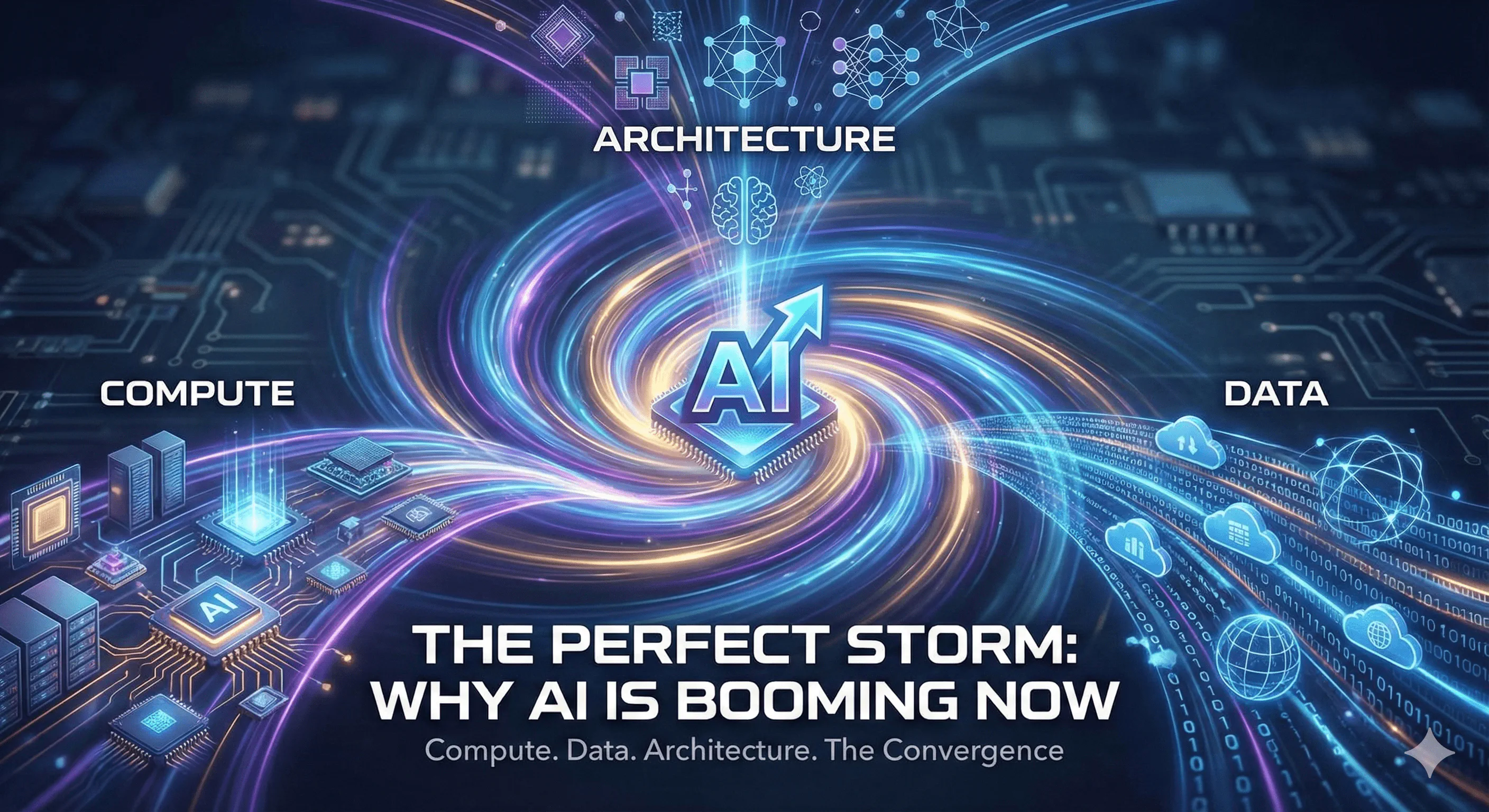
The current AI boom is not due to a single magical discovery. It is a classic “emergence” phenomenon—the result of three massive, independent technological trends advancing separately for years, and finally converging at the exact same moment to create a perfect storm.
To understand the boom, you need to understand the three ingredients of modern AI: Compute, Data, and Architecture.
Info
This article explains the three pillars that together produced the current AI boom: Compute (hardware), Data (scale and diversity), and Architecture (the Transformer and related breakthroughs).
Driver 1: The Engine (Massive Computational Power)
If you want to build a massive skyscraper, you first need to invent steel girders that can support the weight. If you want to build massive AI, you need chips that can handle the math.
For decades, AI theory outpaced computer hardware. The concepts behind neural networks (Deep Learning) existed in the 80s and 90s, but trying to run them on the CPUs of the era was like trying to empty the ocean with a teaspoon.
The Unlikely Hero: The GPU
The turning point came from an unexpected place: the video gaming industry.
Graphics Processing Units (GPUs), most famously made by NVIDIA, were designed to render millions of pixels simultaneously for 3D videogames. It turned out that the exact type of math required to render a realistic explosion in Call of Duty—massive, parallel matrix multiplication—is almost identical to the math required to train a deep neural network.
Around 2010-2012, researchers realized they could repurpose gaming hardware for AI research. Suddenly, calculations that took months could be done in days.
Over the last decade, this hardware has been hyper-optimized specifically for AI. We are now operating with exaflops of compute power—a scale unimaginably larger than what was available even ten years ago.
The takeaway: The engine finally got powerful enough to pull the train.

Driver 2: The Fuel (Big Data & The Internet)
You have the engine, but now you need the fuel.
Modern AI, specifically Deep Learning, doesn’t learn from rules; it learns from examples. To make an AI “smart,” you have to feed it enormous amounts of data.
In the 1990s, finding a digital dataset of 10,000 labeled images was a significant challenge. Today, humanity generates quintillions of bytes of data every single day.
The rise of the internet, social media, smartphones, and IoT devices over the last two decades digitized the human experience. Every tweet, every Wikipedia article, every YouTube video, every GitHub code repository, and every Reddit thread became potential training data.
When training Large Language Models (LLMs) like GPT-4, researchers didn’t just feed it a library; they effectively fed it a significant portion of the public internet.
This explosion of un structured data provided the necessary “textbooks” for these massive models to learn about the world. Without the last 20 years of internet growth, the current AI boom would be impossible.
The takeaway: We finally accumulated enough digital information to teach machines about the real world.
Driver 3: The Spark (Algorithmic Breakthroughs)
We had the compute, and we had the data. But we still needed a better way to connect them.
While “Deep Learning” was the overarching breakthrough that kicked off the modern era (around 2012 with AlexNet), a more recent architectural shift is responsible for the generative AI boom we see today.
The “Transformer” Moment
In 2017, Google researchers published a landmark paper titled “Attention Is All You Need.” It introduced the Transformer architecture.
Before Transformers, AI struggled with “memory” over long sequences. If it was reading a paragraph, by the time it got to the end, it might forget the context of the beginning. Furthermore, previous architectures had to process data sequentially (word by word), which was slow.
The Transformer solved both.
- Attention Mechanism: It allows the AI to “pay attention” to different parts of a sentence at the same time, understanding context far better.
- Parallelization: It allowed the training process to be spread across thousands of GPUs much more efficiently.
The “T” in ChatGPT stands for Transformer. Almost every major generative AI breakthrough in text, image, and video over the last five years is built on the foundation of this 2017 discovery. It was the spark that ignited the fuel.
The Catalyst: Accessibility (The ChatGPT Effect)
The three drivers above had been converging for years. By 2020-2021, powerful models existed in labs. But the general public didn’t care.
Why did the boom enter the mainstream psyche in late 2022? Interface.
Before ChatGPT, interacting with a large language model required coding skills and API access. It was a tool for engineers.
When OpenAI released ChatGPT in November 2022, they didn’t just release a new model; they released a simple chat interface that my grandmother could use. They lowered the barrier to entry from “PhD in Computer Science” to “Can you type a sentence?”
This accessibility catalyzed the massive wave of public interest, investment, and adoption we are seeing now.

Conclusion: The Convergence
Why is AI booming now?
Because we finally have the hardware powerful enough to run the algorithms smart enough to learn from the data large enough to approximate human intelligence.
Remove any one of these three pillars—take away the GPUs, delete the internet’s data, or unseen the Transformer paper—and the boom collapses back into slow, incremental progress.
We are living through a unique historical moment where these exponential curves have intersected. And perhaps the most exciting—and daunting—realization is that all three of these drivers are still accelerating.
